


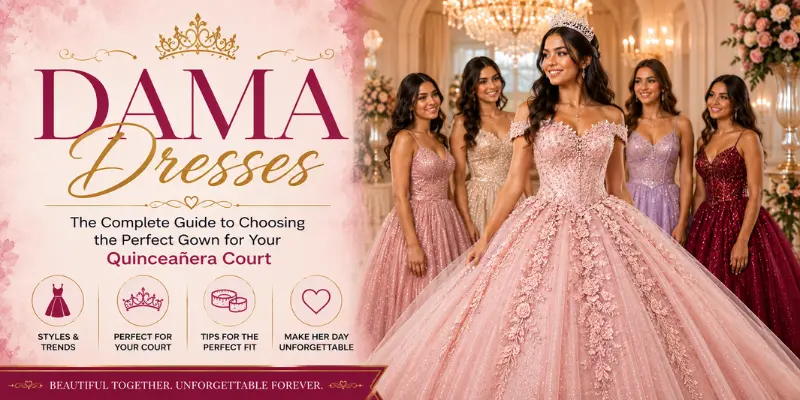
A quinceañera without a stunning court of honor is like a crown without jewels. The damas — the young women who stand beside the birthday girl and share every magical moment — deserve dresses that are just as thoughtful as the celebration itself.
But choosing dama dresses is harder than it looks. You need gowns that complement the quinceañera’s dress, flatter different body types, fit a real budget, and still look breathtaking in photos that families keep for generations.
This guide covers everything your competitors leave out — from fabric choices and alteration tips to who actually pays for the dresses and when to order them.
What Are Dama Dresses?
Dama dresses are the formal gowns worn by the quinceañera’s court of honor (corte de honor) — the group of young women chosen by the birthday girl to share her celebration. Most courts include 7 to 14 damas, each paired with a chambelán (escort).
These dresses serve one critical purpose: they frame the quinceañera, not compete with her. The entire court should read as a unified, elegant group in photos and during the waltz — and the birthday girl should always be the undeniable focal point.
Quick Tip: Think of dama dresses the way a photographer thinks about negative space. The court creates the frame; the quinceañera is the portrait.
Step 1 — Lock In Your Color Palette First
Color is the first decision, and every other choice flows from it. Get this wrong and nothing else can save the look.
The Three Core Color Strategies
Monochromatic: Damas wear the same color as the quinceañera’s gown in a different shade or tone. Classic, elegant, and always cohesive in photos.
Complementary: Damas wear a color that sits across the color wheel from the quinceañera’s gown. Think a blush quinceañera dress paired with dusty sage dama dresses — visually striking without clashing.
Analogous (ombré effect): Damas wear shades of the same color family — for example, lilac, lavender, and deep purple — creating a dreamy gradient effect across the court.
Colors That Photograph Beautifully
- Dusty rose and blush — Timeless, flattering on nearly every skin tone
- Royal blue and navy — Bold, regal, excellent contrast
- Burgundy and wine — Rich and sophisticated for evening celebrations
- Sage and forest green — Fresh, modern, and trending upward in 2024–2025
- Champagne and gold — Luxurious without competing with the quinceañera’s dress
- Terracotta — Warm, earthy, and stunning for outdoor celebrations
Colors to Approach Carefully
Avoid colors that wash out under event lighting (pale yellow, certain whites). If your venue uses warm amber lighting, cool pastels can look washed out — always ask your venue what lighting they use before finalizing a color.
Step 2 — Choose the Right Silhouette
The quinceañera’s gown is almost always voluminous and dramatic. Dama dresses should complement that drama without duplicating it.
A-Line Dresses
The most universally flattering silhouette. Fitted through the bodice and waist, then flaring gently from the hips down. Works beautifully on every body type and allows full freedom of movement for dancing.
Fitted/Sheath Dresses
Sleek and modern. Excellent contrast to a big ball gown quinceañera dress. Best suited for damas with straighter figures who want a polished, sophisticated look.
Chiffon Flowy Gowns
Romantic and ethereal. Especially popular for outdoor or garden quinceañeras. The movement of chiffon photographs beautifully during the waltz.
Short Dresses
Short dama dresses are having a major moment, especially for spring and summer celebrations, bohemian themes, and Sweet 16 crossover parties. They are fun, age-appropriate, and practical for dancing. If the quinceañera’s gown is formal and floor-length, a knee-length dama dress creates elegant contrast without competing.
Mix-and-Match Lengths
A growing trend: some damas in floor-length gowns and others in knee-length, all in the same color. This adds visual dimension to group photos and lets you work with each dama’s personal comfort level. Keep the color and fabric consistent to make the mix feel intentional.
Step 3 — Pick the Right Fabric for Your Season and Venue
This is information almost no competitor gives you — and it matters enormously.
| Fabric | Best Season | Best Venue | Notes |
|---|---|---|---|
| Chiffon | Spring / Summer | Outdoor, Garden | Lightweight, breathable, moves beautifully |
| Satin | Fall / Winter | Indoor ballroom | Lustrous, holds shape, shows sweat in heat |
| Tulle | Any | Any | Adds volume; can be warm; great for ballgown styles |
| Velvet | Fall / Winter | Indoor | Rich texture, dramatic; too heavy for warm venues |
| Lace | Spring / Fall | Church, indoor | Elegant; pairs well with romantic themes |
| Jersey | Any | Any | Stretchy, forgiving, comfortable for dancing |
Pro tip: If your celebration is in a venue without central air conditioning — or in a warm climate — avoid satin and velvet entirely. Your damas will thank you.
Step 4 — Flatter Every Body Type in Your Court
This is where most dama dress guides fail completely. Your court is made up of real people with different bodies — and the goal is for every dama to feel confident and beautiful, not just uniform.
Hourglass Figures
Almost any silhouette works. A-line and fitted styles showcase curves beautifully. Avoid heavy beading at the hips, which can exaggerate width.
Pear-Shaped Figures (fuller hips and thighs)
A-line skirts are your best friend — they skim over the hips and draw the eye up. Empire waist dresses also work well. Avoid pencil skirts or heavily gathered fabric at the hips.
Apple-Shaped Figures (fuller midsection)
Empire waist dresses that fall from just below the bust are extremely flattering. Chiffon and flowy fabrics drape softly over the midsection. Avoid form-fitting silhouettes that constrict the waist.
Petite Figures
Short dresses or high-low hemlines elongate the leg. Avoid overly voluminous skirts that can overwhelm a smaller frame. Vertical embellishments like lace panels also help create the illusion of height.
Tall or Athletic Figures
Floor-length gowns look stunning. Fitted and sheath silhouettes work particularly well. Consider adding interesting back details — a cutout, lace-up, or open back — to add visual interest.
The Practical Solution: Style Within a Color
One of the smartest approaches: choose a color and fabric, then let each dama pick a silhouette that works for her body. The unified color creates cohesion; the different silhouettes mean every dama feels great. Many retailers offer coordinated collections designed exactly for this.
Step 5 — Understand the Neckline Options
Necklines matter more than most people realize — they frame the face in photos and affect how accessories look.
- V-neck — Elongates the neck, flattering on most body types, versatile for jewelry
- Sweetheart — Romantic and classic, popular for quinceañera courts, great with statement earrings
- One-shoulder — Trendy and modern, creates asymmetry that photographs well
- Halter — Great for athletic figures, shows off the shoulders, easy to dance in
- Off-the-shoulder — Romantic and feminine, very popular in 2024–2025 for quinceañera courts
- Square neck — Clean and structured, has a retro-modern feel, very trendy right now
- Strapless — A classic. Works with many body types but requires built-in boning for support
Step 6 — Coordinate Accessories Without Overcrowding
The accessories are what turn a nice dress into a complete look — but over-accessorizing kills the visual harmony of the court.
Jewelry
Choose one statement piece per dama. Either earrings OR a necklace — rarely both. If the dress neckline is elaborate (sweetheart, V-neck with embellishment), skip the necklace entirely and go for elegant drop earrings.
Shoes
Decide as a court: heels or flats. If the celebration includes a lot of dancing — which most quinceañeras do — block heels or kitten heels are far more practical than stilettos. Choose a shoe color that complements rather than exactly matches the dress.
Hair and Makeup
The quinceañera sets the tone. Damas should complement her look, not copy it. If the quinceañera has an updo, damas might wear hair down or in a half-up style to create visual variety without clashing.
Gloves
Traditional in some Latin communities, optional in others. If you’re going formal and traditional, wrist-length gloves in white or a matching color add a classic touch.
Step 7 — Set a Realistic Budget (and Know Who Pays)
This is the question everyone has but nobody answers directly. Here is the honest breakdown:
Who Typically Pays for Dama Dresses?
Tradition: The quinceañera’s family pays for dama dresses as a gift to the court.
Modern reality: More commonly, the cost is split — the quinceañera’s family chooses the dress and pays a portion, and the damas or their families cover the rest.
Important: Have this conversation before choosing the dress, not after. Assuming who pays without discussing it is the fastest way to create stress between families.
Budget Ranges
| Budget Range | What to Expect |
|---|---|
| $60–$120 | Online retailers (ASOS, Amazon, Lulus), basic styles, limited customization |
| $120–$250 | Mid-range boutiques and specialty retailers, better fabrics, more silhouettes |
| $250–$500 | Designer options, premium fabrics, better construction and fit |
| $500+ | Custom or couture; full customization of color, fabric, and silhouette |
Budget tip: When buying for a court of 7–14 damas, even a $20 difference per dress adds up fast. Set the group budget first, then shop within it.
Step 8 — Order Early (Earlier Than You Think)
This is where many quinceañera families get into serious trouble. Dama dresses take time — and running out of time means scrambling for last-minute options that rarely look as good.
Recommended Timeline
| Time Before Celebration | What to Do |
|---|---|
| 6–9 months out | Finalize color palette and style direction |
| 4–6 months out | Order dresses (custom or specialty orders take 8–16 weeks) |
| 6–8 weeks out | Schedule first fitting for all damas |
| 2–3 weeks out | Final fittings and alterations complete |
| 1 week out | Confirm all dresses are ready, cleaned, and pressed |
Warning: Do not order dresses less than 8 weeks before your quinceañera unless you are purchasing ready-to-ship styles. Even “rush” orders can be delayed.
Step 9 — Plan for Alterations
Almost every dama dress will need some alteration — this is normal and expected, not a sign that something went wrong.
Common Alterations
- Hemming — The most common. Expect $15–$60 depending on the fabric and hem style.
- Taking in or letting out the waist/hips — $30–$80.
- Adding a bustle — If the dress has a train, $50–$150.
- Strap adjustments — Simple and usually inexpensive ($15–$30).
- Adding cups or boning — For strapless styles, $30–$60.
Factor alterations into your per-dress budget. A $150 dress that needs $80 in alterations costs $230 total — still a great deal, but know going in.
Step 10 — Navigate Online Shopping Safely
Many families find the best deals on dama dresses online, but online shopping for formalwear has real risks. Here’s how to do it safely.
Before You Buy Online
- Read the size chart on that specific retailer’s site — sizing varies dramatically between brands. Never assume a size 8 from one brand equals a size 8 from another.
- Measure every dama. You need bust, waist, and hip measurements in inches or centimeters — not dress size.
- Read the return policy — Some retailers do not accept returns on formal dresses. Know the policy before you order.
- Look for reviews with photos — Written reviews are easy to fake. Reviews with real customer photos are far more trustworthy.
- Order a size up if between sizes — Taking in a dress is much easier and cheaper than letting it out.
Red Flags to Avoid
- No physical return address or customer service number
- Prices that seem impossibly low (under $30 for a floor-length formal gown)
- No reviews, or all reviews posted on the same day
- Shipping estimated at more than 8 weeks with no rush option
Top Dama Dress Trends for 2024–2025
The quinceañera world evolves every year. Here’s what’s trending right now:
Dusty and muted tones — Dusty rose, sage green, slate blue, and terracotta are replacing the bright, saturated colors of previous years. These shades photograph beautifully and feel modern.
Cowl necklines and draping — Soft, draped necklines give a Grecian, effortless quality that pairs beautifully with chiffon.
Floral and botanical embellishments — 3D floral appliqués, embroidered florals, and petal details are everywhere in 2024–2025 dama collections.
Corset backs — Adjustable lace-up backs are both practical (they accommodate a range of sizes) and stylish.
Two-piece sets — A crop top with a matching skirt is a modern, fashion-forward option popular with younger courts.
Sequin and metallic accents — Not full-sequin gowns, but dresses with sequin bodices or metallic panels that catch the light during the waltz.
High-low hemlines — The best of both worlds: formal from the front, playful from the back.
Frequently Asked Questions
Do all damas have to wear the exact same dress?
No — and many quinceañeras today choose coordinated styles rather than identical dresses. The most important thing is a unified color story and fabric. Different silhouettes can actually look more sophisticated than identical gowns in photos.
Can damas wear white?
Traditionally, no — white is reserved for the quinceañera herself. However, ivory, cream, and champagne are acceptable in some interpretations. Check with the quinceañera’s family before choosing anything near white.
How many damas typically make up a court?
Courts traditionally have 7 or 14 damas to pair with 7 or 14 chambelanes. However, smaller and larger courts are perfectly acceptable. There are no rules — only traditions.
What if one dama can’t afford the dress?
If the quinceañera’s family wants a specific dress and a dama can’t afford it, the options are: (1) the family helps cover the cost, (2) find a less expensive coordinating dress for that dama, or (3) have an honest conversation early so everyone can plan. Avoid last-minute surprises.
Can damas choose their own accessories?
Yes, within guidelines set by the quinceañera. The birthday girl should communicate clearly: “Same color shoes, no necklaces, simple stud earrings” or “Open to jewelry, shoes can vary.” The more specific the guidance, the more cohesive the result.
What happens to the dresses after the quinceañera?
Many damas re-wear their gowns for prom, homecoming, or other formal events. Choosing a classic, versatile silhouette rather than a very theme-specific style gives each dama more options afterward — something worth mentioning when choosing together.
Final Checklist Before You Order
Use this before you place a single order:
- Color palette confirmed with quinceañera
- Silhouette(s) decided — identical or mix-and-match
- Fabric chosen based on season and venue
- Every dama measured (bust, waist, hip)
- Budget set and who pays agreed upon
- Order date planned (at least 4–6 months out)
- Alteration budget included in total cost
- Return policy reviewed for online orders
- Accessories discussed and guidelines shared
- Shoes — heels or flats — decided as a group
The Bottom Line
Dama dresses are one of the most visible elements of any quinceañera — they appear in every photo, every video, and every memory from that day. Choosing them thoughtfully means taking into account color harmony, body diversity, your season and venue, your real budget, and enough lead time for everything to come together beautifully. A GIF maker can also help turn those special moments into memorable visual keepsakes to share after the celebration.
The quinceañera sets the stage. The court brings it to life. When the dama dresses are chosen well, the entire celebration looks intentional, polished, and unforgettable — exactly as it should be.
