

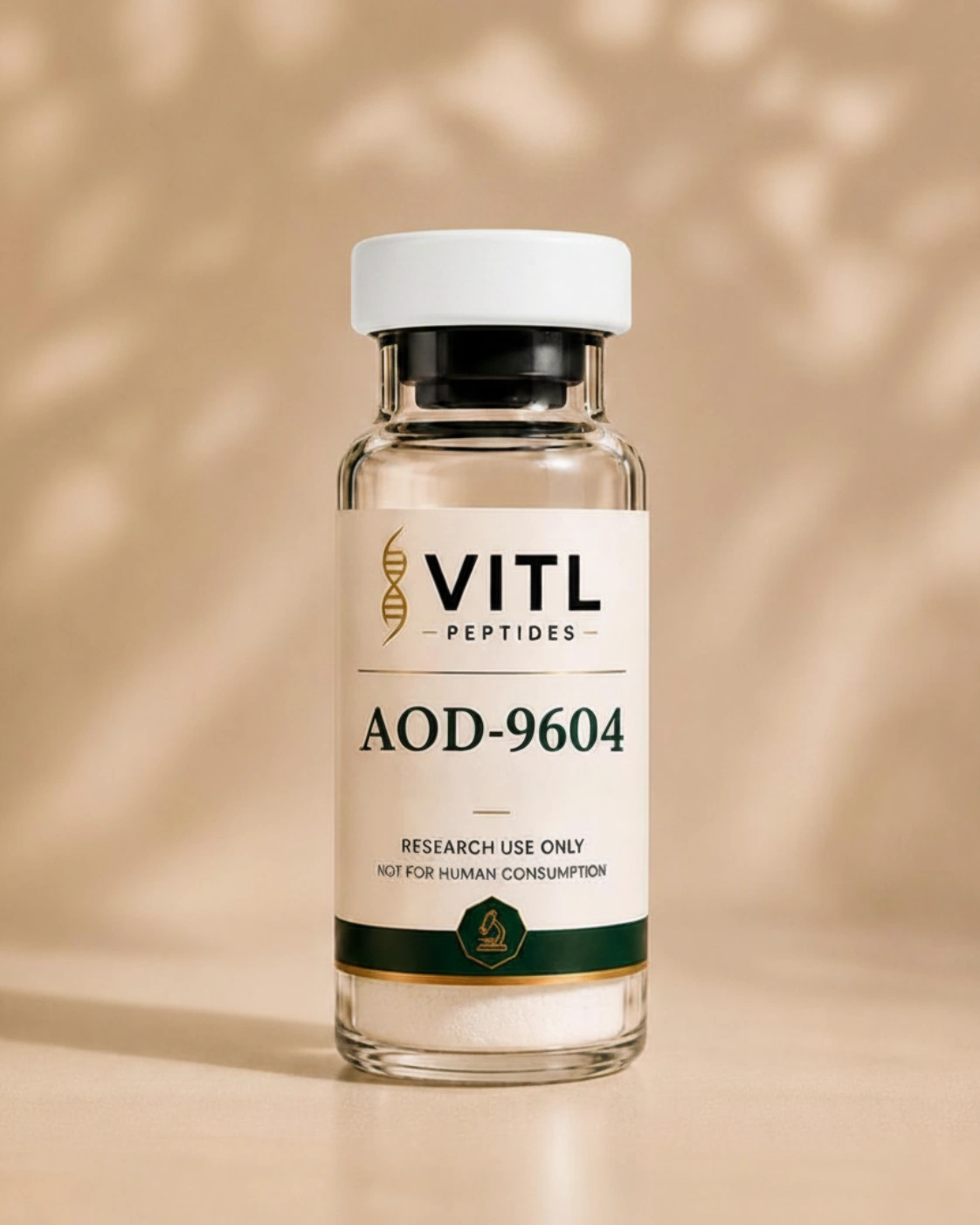
AOD-9604 is a synthetic peptide developed to investigate a specific region of human growth hormone associated with lipid metabolism. Researchers have examined whether this modified fragment behaves differently from the full hormone, particularly in relation to fat metabolism and growth hormone signalling. Its development reflects a broader scientific interest in separating individual biological activities within larger molecules. However, findings from laboratory experiments and animal studies do not establish that AOD-9604 produces weight loss or other clinical benefits in humans.
The AOD-9604 research peptide is listed by VITL Peptides for research purposes. Understanding its scientific background requires attention to its molecular structure, the rationale behind its development and the limitations of the available evidence. These factors help researchers interpret published findings without confusing an experimental compound with an established treatment. AOD-9604 remains a subject of scientific investigation rather than a proven solution for managing body weight.
What Is AOD-9604?
AOD-9604 is a synthetic peptide containing 16 amino acid residues. It is based on the C-terminal region of human growth hormone, with an additional tyrosine residue at the N-terminal end. This structure is why the compound is also described in scientific literature as a modified growth hormone fragment. Although its sequence originates from a region of the larger hormone, AOD-9604 is a distinct molecule and should not be treated as interchangeable with full-length human growth hormone.
The compound was developed to investigate whether the lipid-related activities associated with a particular region of growth hormone could be studied separately from the hormone’s other biological effects. Early research examined its influence on lipid metabolism in experimental models. These investigations provided a scientific basis for further study, but the proposed separation of biological activities does not establish safety or effectiveness in people. The distinction between molecular design and demonstrated outcomes remains central to interpreting the research.
The Molecular Structure Behind AOD-9604
Human growth hormone is a protein consisting of 191 amino acids. AOD-9604 represents a short section derived from its C-terminal region, modified with an additional tyrosine residue. This modification produces a 16-residue synthetic peptide rather than the complete 191-residue hormone. The shorter structure allows researchers to investigate the properties of this particular region without studying the entire parent molecule.
Peptide structure can influence molecular stability, interactions and behaviour under experimental conditions. The sequence, arrangement of amino acids and chemical modifications all contribute to a compound’s identity. Researchers must therefore distinguish AOD-9604 from both the full hormone and unmodified fragments that may have similar naming conventions. Accurate identification is essential when comparing findings across studies.
Why Researchers Examined the C-Terminal Fragment
The research rationale arose from observations that certain effects associated with growth hormone might be linked to regions of the molecule rather than requiring all its structural components. Investigators explored the C-terminal fragment in experimental systems to assess its relationship with lipid metabolism. The aim was to understand whether the fragment retained selected metabolic activities without reproducing the full hormone’s receptor-mediated effects.
This hypothesis required experimental testing rather than assumption. Researchers examined biochemical responses, lipid-related measurements and interactions with cellular systems. The findings helped characterise the compound, but they did not establish that all biological actions of the full hormone could be reproduced or separated reliably in humans. Further evidence is necessary to understand the significance of these observations beyond the original experimental settings.
What Does AOD-9604 Research Investigate?
AOD-9604 research has focused mainly on lipid metabolism, fat storage and the biological processes involved in the handling of fatty acids. Lipid metabolism includes the synthesis, breakdown, transport and storage of fats within the body. These processes are regulated by multiple enzymes, hormones and signalling pathways, making it difficult to attribute a complex metabolic outcome to one molecular interaction. Research on AOD-9604 attempts to clarify whether the modified fragment affects particular aspects of these processes.
Lipolysis and Lipid Storage
Lipolysis is the process through which stored triglycerides are broken down into fatty acids and glycerol. Lipogenesis refers to the formation of lipids, including the synthesis and storage of fat. Both processes contribute to the regulation of energy reserves, but their activity depends on several interacting biological signals. Researchers studying AOD-9604 have investigated whether the peptide influences these processes in experimental models.
Published preclinical studies reported changes in lipid-related measurements following exposure to the compound. Such observations can help identify mechanisms worth investigating further, but they do not establish a predictable effect on human body weight. Changes in a laboratory measurement may not translate into a meaningful clinical outcome. Research findings must be interpreted according to the model, experimental conditions and endpoints used.
Growth Hormone Signalling
Full-length human growth hormone interacts with its receptor and activates signalling pathways involved in growth and metabolism. AOD-9604 was developed to investigate a fragment associated with lipid-related activity rather than the full range of hormone functions. Research has examined whether the modified fragment interacts with the growth hormone receptor in the same way as the intact hormone. Findings from these experiments suggest that the fragment does not simply reproduce the receptor-mediated activity of full-length growth hormone.
This distinction does not mean that AOD-9604 is free from biological risks or that every possible effect is understood. The absence of a particular response in one experimental system cannot establish an overall safety profile. Different biological processes may depend on conditions that are not captured by a single test. Researchers need broader evidence before drawing conclusions about the compound’s effects in humans.
What Have Scientific Studies Found?
Preclinical investigations have explored AOD-9604 in cultured cells and animal models. Researchers assessed lipid-related outcomes and other metabolic measurements to understand how the compound behaved under controlled conditions. Some studies reported changes consistent with the original research hypothesis. These findings contributed to interest in the compound, although their significance must be evaluated alongside the limitations of the experimental designs.
AOD-9604 was also investigated as a potential candidate in human obesity research. However, its development did not establish sufficient evidence of weight-loss efficacy for it to become an approved treatment. The US Food and Drug Administration has discussed AOD-9604 in the context of its regulatory evaluation of proposed bulk drug substances, including questions about its identity, characterisation and safety considerations. Regulatory discussion or inclusion in a research programme does not constitute approval for medical use.
Why Preclinical Results Need Careful Interpretation
Laboratory studies provide controlled conditions for examining biological mechanisms, while animal studies introduce additional physiological complexity. Neither approach can independently establish whether a compound is safe or effective in humans. Differences in metabolism, exposure, biological responses and study design can affect how findings translate between research models. Human clinical evidence is needed to assess outcomes that matter to patients.
Researchers reviewing AOD-9604 studies should distinguish between the types of evidence available:
- In vitro studies: Investigate molecular interactions and cellular responses under controlled laboratory conditions.
- Animal studies: Examine biological effects within an organism, while retaining limitations when predicting human outcomes.
- Human studies: Assess safety, tolerability and clinical outcomes in people, subject to the quality and design of each trial.
- Regulatory assessments: Evaluate specific questions about identity, quality, safety and permitted uses, without necessarily establishing clinical efficacy.
These categories serve different purposes. A result in one category should not be presented as proof of a conclusion that requires evidence from another.
Related Peptides and Their Research Contexts
VITL Peptides lists other research materials with distinct molecular structures and scientific backgrounds. For example, Tesamorelin laboratory research concerns a different peptide with its own relationship to growth hormone-releasing hormone signalling. Tesamorelin should not be treated as equivalent to AOD-9604 simply because both appear in discussions of metabolism. Their structures, biological targets and evidence bases differ.
The catalogue also includes lyophilized TB-500, another research compound with a separate scientific background. Comparing research materials requires examining each compound individually, including its identity, proposed mechanism and available evidence. Similarities in product presentation or broad research categories do not establish shared effects. Researchers should use primary literature and product-specific documentation to assess each material.
Product Documentation and Research Quality
Reliable product documentation helps researchers identify the material under consideration and assess the information available about it. Relevant records may include product identifiers, batch information, analytical results and a certificate of analysis. Each document should be reviewed according to what it actually demonstrates. A purity result, for example, does not independently establish every aspect of identity, sterility or suitability for a particular experiment.
Researchers should also check that product descriptions and analytical records refer to the same compound and relevant batch. Clear documentation supports traceability and helps distinguish verified information from general product claims. Where details are missing or inconsistent, clarification should be obtained before the material is accepted under the laboratory’s procedures. Product documentation supports procurement decisions, but it does not replace independent evaluation of scientific evidence.
For questions about product records or ordering documentation, researchers can contact VITL Peptides. Materials listed by the company are presented for research use, and their availability should not be interpreted as authorisation for human or veterinary use. Scientific claims should remain consistent with the available evidence and the stated restrictions.
Conclusion
AOD-9604 provides a research model for examining a modified fragment of human growth hormone and its relationship with lipid metabolism. Its molecular structure and preclinical findings explain why the compound has attracted scientific interest, but they do not establish clinical effectiveness or long-term safety. Human outcomes must be supported by appropriate clinical evidence rather than inferred from laboratory measurements. A careful reading of the research keeps the compound’s proposed mechanism separate from claims that remain unproven.
Frequently Asked Questions
1. What is AOD-9604?
AOD-9604 is a synthetic 16-residue peptide based on the C-terminal region of human growth hormone, with an additional tyrosine residue. It has been investigated for its relationship with lipid metabolism and is distinct from the full-length hormone.
2. Why has AOD-9604 been studied in metabolic research?
Researchers have investigated whether the modified growth hormone fragment influences lipid-related processes, including lipolysis and lipid storage. These studies aim to clarify its biological activity, but they do not establish clinical benefits in humans.
3. Is AOD-9604 the same as human growth hormone?
No. Human growth hormone is a 191-amino-acid protein, while AOD-9604 is a much shorter, modified peptide derived from a region of that protein. Their structures and biological activities should not be treated as equivalent.
4. Does scientific research prove that AOD-9604 causes weight loss?
No. Preclinical findings and the history of human investigation do not establish sufficient evidence for AOD-9604 as an effective weight-loss treatment. Experimental results should not be presented as proof of clinical efficacy.
5. What should researchers review when assessing AOD-9604 information?
Researchers should examine the study design, experimental model, measured outcomes and limitations of each publication. Product-specific identity records and available analytical documentation should also be reviewed separately from claims about biological activity or clinical effectiveness.
